Die Treppe endete nicht. Sie vergaß.
Nach sieben Stufen – oder siebzig, oder sieben Sekunden, die Zeit war hier in Farbe aufgelöst – verloren die Stufen ihre Überzeugung. Sie wurden unsicher, ob sie noch Stufen sein wollten. Das Türkis zerfaserte. Das Magenta blutete aus. Das Gelb tropfte nach unten wie geschmolzenes Versprechen. Und dann, zwischen einem Schritt und dem nächsten, gab die Treppe auf.
Ich fiel nicht. Ich löste mich auf.
Zuerst die Ränder. Meine Konturen wurden unscharf, begannen in die Umgebung überzugehen. Dann die Substanz. Ich spürte, wie mein Körper sich in Farbe verwandelte – nicht symbolisch, sondern tatsächlich. Meine Haut wurde rosa. Mein Atem gelb. Meine Gedanken ein leuchtendes, aggressives Rot.
Als die Transformation abgeschlossen war, stand ich – falls Stehen noch das richtige Wort war – vor einer Wand.
Aber nicht vor einer gewöhnlichen Wand. Vor einer Wand, die ihre eigene Architektur vergessen hatte.
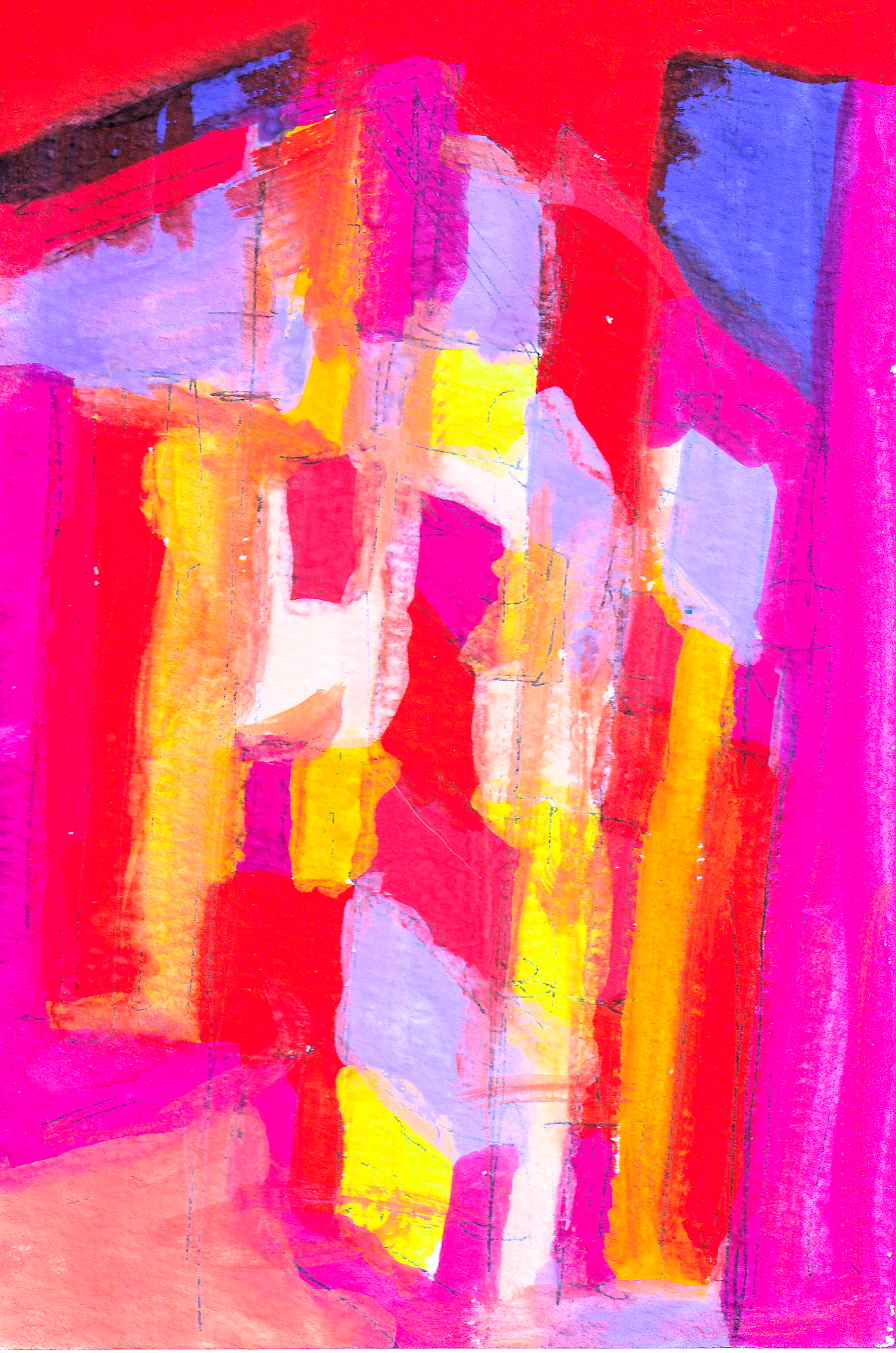
Rot dominierte. Nicht das Rot von Blut oder Feuer. Das Rot von Intensität selbst. Von Gefühlen, die so stark waren, dass sie physisch werden mussten. Es strömte über die Oberfläche wie geronnene Dringlichkeit, schichtete sich übereinander in Tönen von Scharlach bis Karmin, von Rosa bis zu einem fast violetten Purpur.
Aber das Rot war nicht allein.
Gelbe Streifen durchschnitten es – nicht sauber, nicht geometrisch, sondern gemalt. Als hätte jemand mit einem riesigen Pinsel gegen die Realität selbst geschlagen und Spuren hinterlassen. Diese gelben Bahnen tropften nach unten, verliefen in sich selbst, hinterließen orange Verläufe dort, wo sie das Rot berührten. Manche waren vertikal. Andere diagonal. Einige hatten ihre Richtung vergessen und liefen einfach in beliebige Entscheidungen.
Weiße Flächen öffneten sich wie Wunden. Nicht das strahlende Weiß des Versprechens. Nicht das erschöpfte Weiß der Spirale. Das Weiß der Leere. Des Nichtmehrwissens. Rechteckige Aussparungen, als hätte jemand Teile der Wand herausgeschnitten und vergessen, sie zu ersetzen. Durch sie sah ich nichts. Keine anderen Räume. Keine Fenster. Nur die Abwesenheit von Farbe, so vollständig, dass sie selbst zu einer Farbe wurde.
Oben, im oberen Drittel, leuchteten zwei blaue Flächen. Lavendel fast, ein zartes, müdes Blau. Sie wirkten fehl am Platz, wie Erinnerungen an einen Himmel, der hier nie existiert hatte. Aber sie waren wichtig. Ich spürte es. Sie hielten etwas zusammen. Oder sie ließen etwas los.
“Du bist in der Wand”, sagte eine Stimme. Nicht von außerhalb. Von innerhalb. Sie kam aus den Farbschichten selbst, aus den Übergängen zwischen Rot und Gelb, aus den Verläufen, wo Orange entstand und sofort wieder verging.
“Was ist das hier?”
“Das ist, was übrig bleibt, wenn Architektur ihre Form verliert. Der Architekt kam hierher, nachdem er den Turm gebaut hatte. Er dachte, er hätte alles verstanden – Raum, Zeit, Geometrie, Farbe. Aber dann erkannte er: All das waren nur Strukturen. Krücken. Notbehelfe. Die Wahrheit lag dahinter. In der Auflösung.”
Ich berührte die rote Oberfläche. Sie war nicht fest. Sie gab nach, wie Samt, wie Haut, wie etwas Lebendes. Unter meiner Handfläche pulsierte Wärme. Das Rot reagierte auf mich, intensivierte sich an der Berührungsstelle, leuchtete heller, als wolle es mich verschlingen oder umarmen – vielleicht beides.
“Die Wand ist nicht gemalt”, fuhr die Stimme fort. “Sie ist geworden. Jede Schicht ist eine aufgelöste Struktur. Das Rot – das sind alle Magentafarbenen Räume, die du durchquert hast, verflüssigt zu purer Emotion. Das Gelb – die Korridore der Versprechen, geschmolzen zu Hoffnung ohne Richtung. Das Weiß – die Momente, in denen du aufgehört hast zu verstehen.”
Ich trat zurück. Die Wand erstreckte sich in alle Richtungen, ohne Rand, ohne Grenze. Oben, unten, links, rechts – alles verschwamm. Es gab keinen Raum mehr um die Wand herum. Die Wand war der Raum. Ich stand nicht davor. Ich stand in ihr. Ich war bereits Teil ihrer Schichtung geworden.
Die gelben Streifen begannen sich zu bewegen. Langsam, zäh, wie Honig, der bergauf fließt. Sie krochen über das Rot, hinterließen orangefarbene Spuren, vermischten sich mit den weißen Flächen zu einem blassen Creme, das sofort wieder verschwand. Nichts war stabil. Alles war im Prozess des Werdens und Vergehens gleichzeitig.
“Hier gibt es keine Türen mehr”, sagte die Stimme. “Keine Treppen. Keine Korridore. Nur Übergänge. Von einer Farbe zur nächsten. Von einem Zustand zum anderen. Der Architekt hat aufgehört zu bauen und begonnen zu malen. Mit Raum. Mit Zeit. Mit dir.”
“Mit mir?”
“Deine Reise ist Teil der Wand geworden. Jeder Schritt, den du gemacht hast, hat eine neue Schicht hinzugefügt. Das Türkis deines Anfangs. Das Magenta deiner Verwirrung. Das Gelb deiner falschen Hoffnungen. Das Violett deiner Auflösung. Alles ist hier. Übereinander. Ineinander. Du malst dich selbst.”
Ich blickte auf meine Hände. Sie waren rot geworden. Nicht bemalt – rot. Als hätte die Wand beschlossen, mich zu adoptieren, mich in ihre Palette aufzunehmen. Unter der roten Oberfläche schimmerten andere Farben – Gelb an den Fingerspitzen, Weiß an den Gelenken, ein zartes Rosa an den Handflächen.
Die blauen Flächen oben begannen zu sinken. Nicht nach unten – durch die anderen Farben hindurch. Sie drangen ins Rot ein, vermischten sich, erzeugten ein stumpfes Violett, das sofort wieder verblasste. Sie waren wie Gewichte, die durch Flüssigkeit sanken, aber die Flüssigkeit war fest und die Gewichte waren gasförmig.
“Was soll ich hier tun?”
“Nichts”, antwortete die Stimme. “Oder alles. Beides ist identisch. Du kannst warten, bis die Wand dich vollständig absorbiert hat. Dann wirst du Teil der Farbe, eine weitere Schicht, ein weiterer Übergang. Viele wählen das. Es ist nicht schmerzhaft. Es ist wie nach Hause kommen zu einem Ort, an dem du nie warst.”
“Oder?”
“Oder du gehst durch. Die Wand ist nicht nur eine Oberfläche. Sie ist ein Durchgang. Aber nicht von einem Ort zum anderen. Von einem Zustand zum nächsten. Du musst aufhören, Raum zu denken. Aufhören, dich als getrennt zu denken. Du musst Farbe werden.”
Das Rot um mich herum intensivierte sich. Es drang in meine Augen, färbte meine Sicht. Alles wurde rot gefiltert – das Gelb wurde zu Orange, das Weiß zu Rosa, die blauen Flächen zu Violett. Die Welt verlor ihre Nuancen, wurde monochrom, wurde zur Variation eines einzigen Themas.
Ich spürte, wie meine Gedanken sich auflösten. Nicht verschwanden – auflösten. Jeder Gedanke war ein gelber Streifen, der durch das Rot meines Bewusstseins lief, sich vermischte, neue Farben erzeugte, die sofort wieder verflossen. Ich konnte nicht mehr denken. Ich konnte nur noch färben.
Und dann, in der Mitte der Wand – oder war ich die Mitte? – öffnete sich ein Riss.
Nicht sichtbar. Fühlbar.
Ein Spalt zwischen zwei Rottönen, eine Differenz so minimal, dass sie fast nicht existierte. Aber sie war da. Eine Möglichkeit. Ein Durchgang zu etwas, das weder Raum noch Zeit noch Farbe war.
“Das ist es”, flüsterte die Stimme. “Der Übergang. Hier hört das Gebäude auf, Gebäude zu sein. Hier beginnt es, Idee zu sein. Der Architekt ist nie hindurchgegangen. Er hatte Angst vor dem, was dahinter lag. Oder davor, dass nichts dahinter lag. Beides war gleich beängstigend.”
Ich legte meine rote Hand in den Riss.
Er fühlte sich an wie das Gegenteil von Berührung. Wie Anti-Kontakt. Wie der Moment zwischen zwei Herzschlägen, wenn für eine Millisekunde der Tod möglich ist.
Ich drückte.
Die Wand gab nach. Das Rot teilte sich. Das Gelb zersplitterte. Das Weiß verdampfte. Die blauen Flächen fielen aus der Realität wie vergessene Notizen.
Und dahinter –
– war keine Farbe.
Keine Nicht-Farbe.
Sondern etwas, das vor der Erfindung von Farbe existiert hatte.
Ich trat hindurch.
Und die Wand schloss sich hinter mir, malte mich aus ihrer Erinnerung, wie ich nie dagewesen wäre.
Aber die Spuren blieben.
Ein neuer Rotton.
Etwas wärmer als zuvor.
Chapter 8: The wall that remembers being liquid
The staircase did not end. It forgot.
After seven steps—or seventy, or seven seconds, time dissolved into color here—the steps lost their conviction. They became unsure whether they still wanted to be steps. The turquoise frayed. The magenta bled out. The yellow dripped down like a melted promise. And then, between one step and the next, the staircase gave up.
I didn’t fall. I dissolved.
First the edges. My contours became blurred, began to merge with my surroundings. Then the substance. I felt my body turning into color—not symbolically, but actually. My skin turned pink. My breath yellow. My thoughts a bright, aggressive red.
When the transformation was complete, I stood—if standing was still the right word—in front of a wall.
But not an ordinary wall. A wall that had forgotten its own architecture.
Red dominated. Not the red of blood or fire. The red of intensity itself. Of feelings so strong that they had to become physical. It flowed across the surface like coagulated urgency, layering itself in shades from scarlet to carmine, from pink to an almost violet purple.
But the red was not alone.
Yellow stripes cut through it—not clean, not geometric, but painted. As if someone had struck reality itself with a giant brush and left marks. These yellow streaks dripped down, ran into themselves, leaving orange gradients where they touched the red. Some were vertical. Others diagonal. Some had forgotten their direction and simply ran in random directions.
White areas opened up like wounds. Not the bright white of promise. Not the exhausted white of the spiral. The white of emptiness. Of no longer knowing. Rectangular recesses, as if someone had cut out parts of the wall and forgotten to replace them. I couldn’t see anything through them. No other rooms. No windows. Only the absence of color, so complete that it itself became a color.
Above, in the upper third, two blue areas glowed. Almost lavender, a delicate, tired blue. They seemed out of place, like memories of a sky that had never existed here. But they were important. I could feel it. They held something together. Or they let something go.
“You are in the wall,” said a voice. Not from outside. From inside. It came from the layers of paint themselves, from the transitions between red and yellow, from the gradients where orange emerged and immediately faded again.
“What is this?”
“This is what remains when architecture loses its form. The architect came here after he built the tower. He thought he understood everything—space, time, geometry, color. But then he realized: All of that was just structure. Crutches. Makeshift solutions. The truth lay behind it. In the dissolution.”
I touched the red surface. It wasn’t solid. It gave way, like velvet, like skin, like something alive. Warmth pulsed beneath my palm. The red reacted to me, intensifying where I touched it, glowing brighter, as if it wanted to devour me or embrace me – perhaps both.
“The wall isn’t painted,” the voice continued.
“It has become. Each layer is a dissolved structure. The red – that’s all the magenta-colored rooms you’ve passed through, liquefied into pure emotion. The yellow – the corridors of promise, melted into directionless hope. The white – the moments when you stopped understanding.”
I stepped back. The wall stretched in all directions, without edge, without boundary. Above, below, left, right—everything blurred. There was no more space around the wall. The wall was the space. I was not standing in front of it. I was standing in it. I had already become part of its stratification.
The yellow stripes began to move. Slowly, viscously, like honey flowing uphill. They crawled over the red, leaving orange traces, mixing with the white areas to form a pale cream that immediately disappeared again. Nothing was stable. Everything was in the process of becoming and passing away at the same time.
“There are no more doors here,” said the voice. “No stairs. No corridors. Only transitions. From one color to the next. From one state to another. The architect has stopped building and started painting. With space. With time. With you.“
”With me?“
”Your journey has become part of the wall. Every step you took added a new layer. The turquoise of your beginning. The magenta of your confusion. The yellow of your false hopes. The violet of your dissolution. Everything is here. On top of each other. Inside each other. You paint yourself.”
I looked at my hands. They had turned red. Not painted – red. As if the wall had decided to adopt me, to include me in its palette. Other colors shimmered beneath the red surface – yellow at my fingertips, white at my knuckles, a delicate pink on my palms.
The blue areas at the top began to sink. Not down – through the other colors. They penetrated the red, mixed together, creating a dull violet that immediately faded again. They were like weights sinking through liquid, but the liquid was solid and the weights were gaseous.
“What should I do here?”
“Nothing,” replied the voice. “Or everything. Both are identical. You can wait until the wall has completely absorbed you. Then you will become part of the color, another layer, another transition. Many choose that. It is not painful. It is like coming home to a place you have never been.”
“Or?”
“Or you go through. The wall is not just a surface. It is a passageway. But not from one place to another. From one state to the next. You have to stop thinking in terms of space. Stop thinking of yourself as separate. You have to become color.”
The red around me intensified. It penetrated my eyes, coloring my vision. Everything was filtered through red—the yellow became orange, the white became pink, the blue areas became violet. The world lost its nuances, became monochrome, became a variation on a single theme.
I felt my thoughts dissolving. Not disappearing – dissolving. Every thought was a yellow streak running through the red of my consciousness, mixing, creating new colors that immediately faded away again. I could no longer think. I could only color.
And then, in the middle of the wall—or was I the middle?—a crack opened.
Not visible. Tangible.
A gap between two shades of red, a difference so minimal that it almost didn’t exist. But it was there. A possibility. A passage to something that was neither space nor time nor color.
“This is it,” whispered the voice. “The transition. This is where the building stops being a building. This is where it begins to be an idea. The architect never went through it. He was afraid of what lay beyond. Or afraid that there was nothing beyond. Both were equally frightening.”
I placed my red hand in the crack.
It felt like the opposite of touch. Like anti-contact. Like the moment between two heartbeats when, for a millisecond, death is possible.
I pressed.
The wall gave way. The red split apart. The yellow shattered. The white evaporated. The blue areas fell out of reality like forgotten notes.
And behind it—
—there was no color.
No non-color.
But something that had existed before the invention of color.
I stepped through.
And the wall closed behind me, painting me out of its memory as if I had never been there.
But the traces remained.
A new shade of red.
Slightly warmer than before.
Leave a Reply